




Asia Bike Tours will be there live – Hall B3 | Booth B3-209. Meet us in person, get inspired for your next big motorcycle journey and dive into a world of freedom, adventure and true wanderlust.
November 22, 2026
On the morning of 26 August, a huge mass of glacier ice and rock broke away high up near the Nepal–Tibet border. It set off a flash flood that tore down the Bhotekoshi River into Nepal and on through the Trishuli and Narayani valleys. Homes, roads, bridges and hydropower plants were swept away, and more than 1,400 people lost their lives. It was one of the worst disasters Nepal has seen in many years.
The Trishuli valley is exactly where our route leaves Kathmandu heading west, and the flood had damaged the road we needed in several places. For our October tour, everything was already in place: hotels, motorcycles, permits, and nine guests counting down the days. So we had to ask ourselves a hard question. Do we go, or do we cancel?
We didn't answer that question quickly. We have been riding in Nepal for many years, and we have learned how fast roads here are cleared and rebuilt after a landslide, and how important it is to know the situation on the ground rather than from the news. For weeks we were in touch with our team in Nepal almost every day. We followed the road reports section by section and worked out alternatives in case a stretch stayed closed. Only when we were confident we could ride safely did we decide to go.

There was one more reason, and it mattered to us. A disaster like this is hard enough on a country like Nepal. When the tourists stay away as well, the people who live from tourism are hit a second time: the guesthouse owners, drivers, cooks, mechanics and guides. Our friends in Nepal were hoping we would come, and we wanted to be there.
One by one the roads reopened, often only a few days before we reached them. October is normally the busiest month of the year in Nepal, and the Annapurna region and Mustang are among its most popular corners. This year, after the flood, many travellers stayed away.
Nepal always has places where you can be alone, but this autumn even the well-known routes felt empty. We often had passes to ourselves, lodges with only our group, and monasteries where the only sound was the prayer flags in the wind.

This tour was the first run of our new route, which links two valleys on opposite sides of the Annapurna massif. From Kathmandu we rode west to Gorkha, the old royal town where the unification of Nepal began, and then north up the Marsyangdi valley via the village of Tal to Manang. At around 3,500 metres, the valley opens up wide beneath the ice walls of Annapurna and Gangapurna.
There is no road over Thorong La, the high pass between the two valleys, so we rode back down to Besisahar and on to Pokhara. From there we turned north into the Kali Gandaki, the deep gorge between Dhaulagiri and Annapurna, and climbed via Kalopani and Ghami into Upper Mustang, all the way to Lo Manthang, where we stayed for two nights. On the way back we stopped in Marpha, then rode via Kusma and the hilltop town of Bandipur back to Kathmandu.
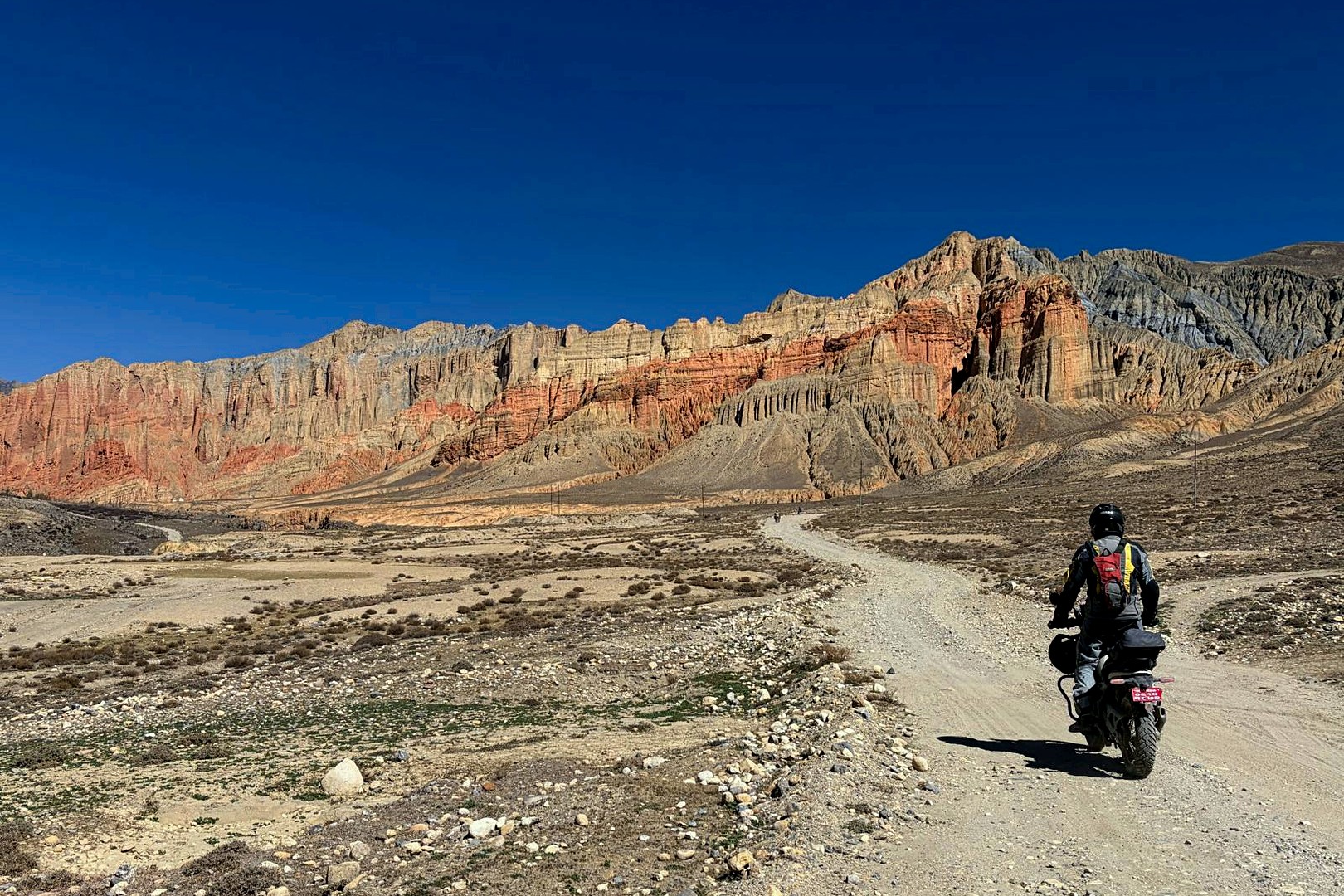
Much of the route is real off-road riding: gravel, loose rock, river crossings and tracks that keep you focused all day. It's not the place for your first ride away from paved roads, but it's exactly why people come to ride in Nepal. The reward is the view. Along the way we had almost half a dozen 8,000-metre peaks in sight, Annapurna, Dhaulagiri and Manaslu among them. Anyone who has stood next to their bike early in the morning beneath those mountains will understand why we keep coming back.
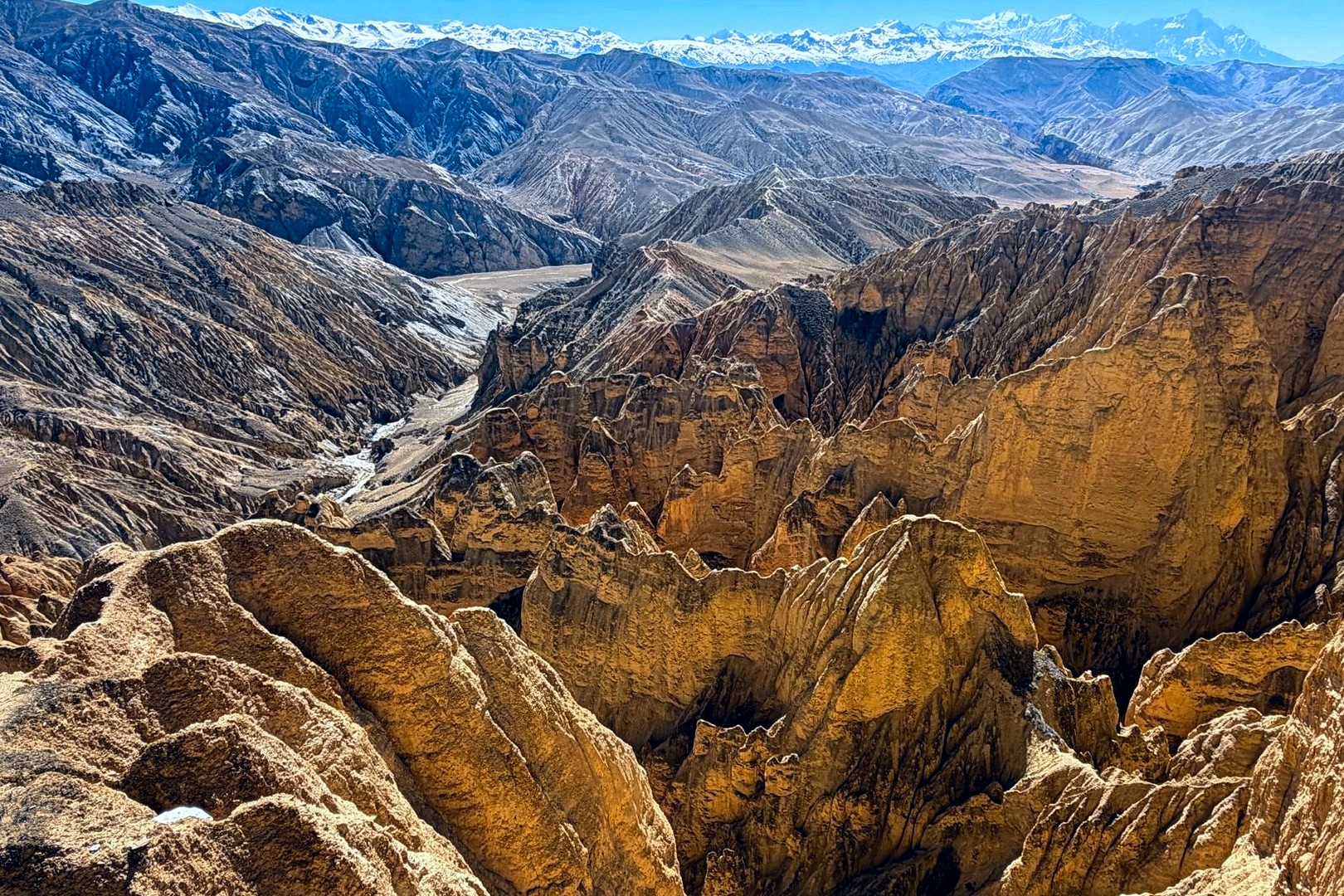
Riding from Manang to Mustang, you see how much the landscape changes once you are behind the big mountains. Mustang lies in the rain shadow of Annapurna and Dhaulagiri. The monsoon clouds drop their rain on the southern slopes, and very little of it reaches the valleys behind. The result is a high-altitude desert that looks more like the Tibetan Plateau than the rest of Nepal: dramatic cliffs, deep canyons and rock in red, ochre and grey.
The same isolation has protected the culture. Lo Manthang, the walled capital of the old kingdom of Lo, is still a living centre of Tibetan Buddhism, with its monasteries, mud-brick houses and narrow lanes. The road arrived long ago and Mustang has changed, but what remains of its remoteness still takes your breath away.

Then came something none of us expected. The flood destroyed Rasuwagadhi, Nepal's main border crossing to Tibet, and a few days later the Tatopani crossing was closed as well because of the landslide risk. That left Kora La in Upper Mustang, at 4,650 metres, as the only open crossing to China, and almost all trade moved there.
The numbers are hard to believe. In the month before the flood, around 100 electric cars came over Kora La. Between mid-September and mid-October, the customs office in Mustang cleared more than 3,100 of them, as many in one month as in the whole year before.
Many of them don't come down on a truck. Local drivers take the brand-new cars the roughly 250 kilometres to Pokhara themselves, because it's cheaper than shipping them and it brings welcome income to many families. That means gravel tracks, river crossings and roads these cars were never built for. We saw the results with our own eyes: shiny new electric cars at the roadside with flat batteries or broken suspension.

At first we wondered why anyone would bring an electric car into a country where so many roads are still gravel. The answer, as so often, is money. A new electric car is taxed at around 10 per cent when it is imported, a petrol car at up to 238 per cent. For a family in Kathmandu, that is the difference between a car they can afford and one they can't. When fuel prices climbed this year, the choice became even easier. Today, nearly eight out of ten new passenger cars coming into Nepal are electric.
On the road, you see it everywhere. There are charging stations at petrol pumps, at hotels and at simple roadside eateries, around 2,300 across the country by now. The network reaches all the way into Mustang, where a carmaker has even built one in Tsarang. It's fascinating to watch a country that is still building many of its roads skip straight ahead to electric.
It got us thinking, too. On two wheels the change is only just beginning. Almost all electric two-wheelers in Nepal are still scooters, and proper adventure bikes with batteries are rare. But who knows: one day an electric motorcycle tour with Asia Bike Tours might be more than just an idea. We're watching closely.

For us, this was one of the most beautiful tours we've ever ridden, not in spite of the circumstances but partly because of them. What stays with us most, though, is Nepal itself. The people who welcomed us everywhere, even in valleys still recovering from the flood. Sweet milk tea at roadside stops, dal bhat after a long day in the saddle and Thakali cooking in the Kali Gandaki. Prayer flags on every pass, monasteries in the morning light, and quiet evenings inside the walls of Lo Manthang.
Thank you to our nine guests for riding with us, and to our team in Nepal, who made all of it possible.
The next Manang & Mustang tour starts on 16 October 2027, for anyone who'd like to see Nepal while it still feels like this. You'll find all the details on our Mustang tour page. And if you have questions, just write to us. We're always happy to tell more stories from the road.


Asia Bike Tours will be there live – Hall B3 | Booth B3-209. Meet us in person, get inspired for your next big motorcycle journey and dive into a world of freedom, adventure and true wanderlust.
Asia Bike Tours live at Moto Austria 2027 · 5–7 February · Wels · Tour Talks, Meet & Greet & real motorcycle adventures across Asia